
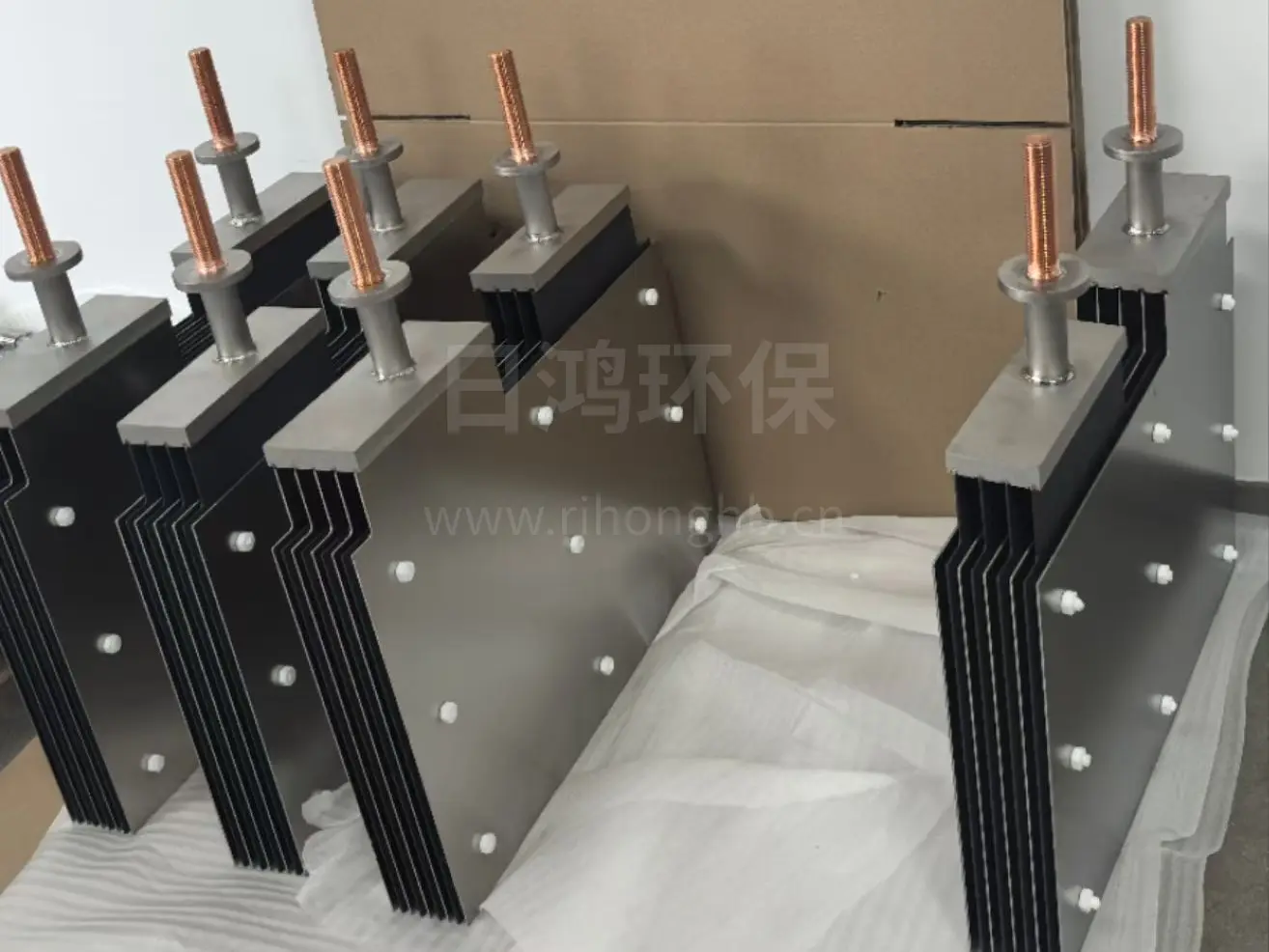
Electrocatalytic Oxidation (ECO) Reactor: "Green Electrolysis" Equipment for Deep Mineralization of Refractory Wastewater
Facing complex wastewater from pharmaceuticals, pesticides, dyes, landfill leachate, and other sources characterized by "high toxicity, high salinity, and poor biodegradability," conventional biological treatment and traditional Fenton processes often fall into the dilemma of slow degradation, byproduct sludge, and high costs. The Electrocatalytic Oxidation (ECO) reactor utilizes insoluble anodes (DSA / BDD) under a direct current electric field to progressively mineralize organic matter into carbon dioxide and water through a dual mechanism of "direct electron transfer + indirect oxidation by active species"—without the need for added iron salts and without generating Fenton iron sludge. It is a clean electrochemical solution for deep purification and detoxification of refractory wastewater.
I. Product Positioning
Electrocatalytic Oxidation (ECO) is the equipmentized form of Electrochemical Advanced Oxidation Processes (EAOPs). It uses special catalytic electrodes (such as DSA, BDD, etc.) as anodes, and under direct current drive, generates strong oxidizing species such as ·OH at the electrode/solution interface, performing non-selective oxidative chain scission on refractory organic matter in water, ultimately mineralizing it into CO₂ and H₂O. The equipment integrates an electrolytic cell, dedicated power supply, temperature control, and intelligent control into one unit, adopting a modular steel integrated design. It can be installed above ground, expanded in parallel modules, and is ready to use upon connection, making it easy to embed into existing process chains or for decentralized point-source treatment.
II. Working Principle (Brief)
Raw water inlet: Wastewater to be treated enters the electrolytic reaction zone, and after uniform water distribution, electrocatalytic oxidation treatment begins.
Electrocatalytic anode zone: Water molecules undergo oxidation on the catalytic anode surface, generating strong oxidizing free radicals such as ·OH in situ; organic matter undergoes direct electron transfer at the electrode interface while also being indirectly oxidized by free radicals.
Oxidative degradation zone: Free radicals non-selectively attack refractory macromolecules, causing ring opening, chain scission, and mineralization, simultaneously removing color and biological toxicity, and enhancing the biodegradability of the effluent.
Clear water outlet: The degraded clear water is discharged from the outlet end, and a very small amount of electrode spalling or precipitates are collected and disposed of through the sludge discharge system, completing the synergistic purification of "catalysis + oxidation + mineralization."
Process flow: Raw water → Electrocatalytic anode zone (in situ ·OH generation) → Oxidative degradation zone (chain scission / mineralization / detoxification) → Treated effluent
The entire process is carried out under mild conditions of normal temperature and pressure, without relying on large amounts of external chemicals; when combined with electrocoagulation (EC), EC first destabilizes and removes turbidity, and ECO continues with deep mineralization, forming a cascade electrochemical treatment chain of "electrocoagulation + electrocatalysis," leveraging EC's advantages in turbidity and oil removal while supplementing ECO's ability to deeply reduce refractory COD.
III. Core Advantages
① Generates free radicals from electricity, no iron sludge concernsCompared to Fenton, it does not require large doses of chemicals, resulting in less secondary pollution and significantly lower sludge volume than chemical oxidation routes.
② Broad-spectrum chain scission, specialized for refractory compoundsNon-selective oxidation of high-salinity, toxic, and colored organic matter, a nemesis for "bottleneck" COD in biological tailwater.
③ Normal temperature and pressure, mild conditionsNo need for high temperature and pressure, wide pH adaptation window, safe and easy to control operation.
④ Intelligent control, stable and efficientConstant current/constant voltage + automatic pole reversal/pulse power supply, inhibiting electrode passivation and scaling, ensuring stable operation.
⑤ Compact modular design, ready to useSteel integrated enclosure, small footprint, modular parallel expansion, suitable for retrofits and decentralized point sources.
⑥ Cascade coupling capabilityFlexible combination with biological treatment, electrocoagulation, ozone, etc., easily embedded into existing process chains for deep polishing.
IV. Main Technical Parameters (Reference Range)
Item | Parameter Range / Description | Remarks |
|---|---|---|
Single unit capacity | 0.5 – 30 m³/h (modular parallel expansion available) | Customized by model |
Electrode type | DSA (Ti-based noble metal oxide) / BDD (boron-doped diamond) / Ti-PbO₂ | Selected based on water quality |
Power supply mode | DC stabilized, constant current or constant voltage, pulse power supply supported | Equipped with automatic pole reversal |
Current density | Approx. 20 – 200 A/m² | Adjusted according to water quality and removal requirements |
Electrode plate spacing | Approx. 3 – 15 mm | Affects energy consumption and mixing |
Hydraulic retention time | Approx. 15 – 120 min | Higher range for advanced treatment |
COD removal rate | Approx. 30% – 80% | Depends on refractory fraction in raw water |
Color removal rate | Approx. 70% – 95% | Significant for printing/dyeing and chemical wastewater |
Applicable pH window | Approx. 3 – 9 | Depends on electrode material |
Salinity adaptability | Can adapt to high-salinity wastewater | High conductivity favors energy savings |
* The above are typical reference ranges. Actual removal performance varies with raw water quality, electrode combination, and operating conditions. Specific values should be determined through bench tests or on-site parameter adjustment.
V. Typical Application Scenarios
Industry / Wastewater Type | Main Removal Targets |
|---|---|
Pharmaceutical / pesticide wastewater | Refractory intermediates, antibiotic residues, highly toxic organics |
Chemical / fine chemical wastewater | High-salinity refractory organics, colored pollutants |
Printing / textile wastewater | Advanced decolorization and COD reduction of biological tailwater |
Industrial park comprehensive wastewater | Upgrading biological tailwater, toxicity reduction, biodegradability enhancement |
Landfill leachate | Deep mineralization of membrane concentrate / aged leachate |
Electroplating / surface treatment | Degradation of complexed organics and additives |
Pre-treatment for water reuse | Removal of refractory trace organics to ensure reuse water quality |
VI. Selection Recommendations
Electrocatalytic oxidation equipment is more suitable for deep degradation of refractory compounds, detoxification, and upgrading standards—i.e., reduction of refractory COD in biological tailwater, toxicity removal, color removal, and pre-treatment destabilization of high-salinity refractory wastewater. Due to its reliance on electrical energy, the unit treatment cost increases with removal depth. It is recommended to prioritize its use at nodes with "small water volume but high difficulty," or as a deep polishing unit after biological treatment. For very low-concentration large-volume wastewater or scenarios requiring extreme mineralization, it should be combined with biological treatment, ozone, Fenton, etc., to form a cascade treatment. Before operation, bench tests are recommended to determine electrode selection, current load, and retention time; high-hardness or high-suspended-solids water quality requires pre-treatment for hardness removal/filtration to avoid electrode contamination and scaling.
Let "biologically undegradable" wastewater
Let "biologically undegradable" wastewater be handled by electrocatalysis
We can provide bench-scale testing devices, electrode selection, and integrated equipment configuration solutions. Welcome to call or leave a message to obtain process configuration recommendations tailored to your water quality.
Contact Us Now →Related Products
Boron-Doped Diamond (BDD) Electrode
Facing complex wastewater from pharmaceuticals, pesticides, dyes, and landfill leachate—characterized by "high toxicity, high salinity, and poor biodegradability"—traditional biological treatment and conventional Fenton often struggle with slow degradation, secondary sludge production, and high costs. Boron-Doped Diamond (BDD) electrodes, with their extremely wide electrochemical potential window and ultra-high oxygen evolution overpotential, in-situ enrich strong oxidizing species such as hydroxyl radicals, active chlorine, persulfate, and even ozone on the anode surface, directly "mineralizing" organic matter into carbon dioxide and water—making them the core electrode consumable for electrocatalytic oxidation (ECO) equipment to achieve deep purification.
Titanium Anodes for Wastewater Treatment
The performance of electrochemical water treatment processes such as electrocatalytic oxidation, electrolytic chlorine disinfection, and electro-Fenton fundamentally depends on the electrode. Traditional soluble anodes (such as aluminum and iron) are consumed quickly, require frequent electrode replacement, and introduce additional metal ions into the water. This product is a Dimensionally Stable Anode (DSA) made with industrial pure titanium as the substrate and a noble metal oxide active layer coated on the surface. It is insoluble, long-lasting, and has tunable catalytic properties, making it the "heart" component for long-term stable operation of electrochemical wastewater treatment equipment.