Heterogeneous Catalytic Oxidation Tower
Wastewater from chemical, pharmaceutical, printing and dyeing, coking, landfill leachate and other industries often contains refractory, biotoxic, highly colored organic matter. Biological treatment alone often falls into the dilemma of "difficult to meet standards and unstable operation"; ozone oxidation alone also has the shortcomings of strong selectivity and low utilization. This product uses a solid catalyst bed to activate ozone in situ into highly active hydroxyl radicals (·OH), efficiently breaking chains and mineralizing organic matter at room temperature and pressure. The catalyst does not dissolve out and hardly produces iron sludge, making it a mainstream solution for advanced upgrading of biological tailwater and RO concentrate.
I. Product Positioning
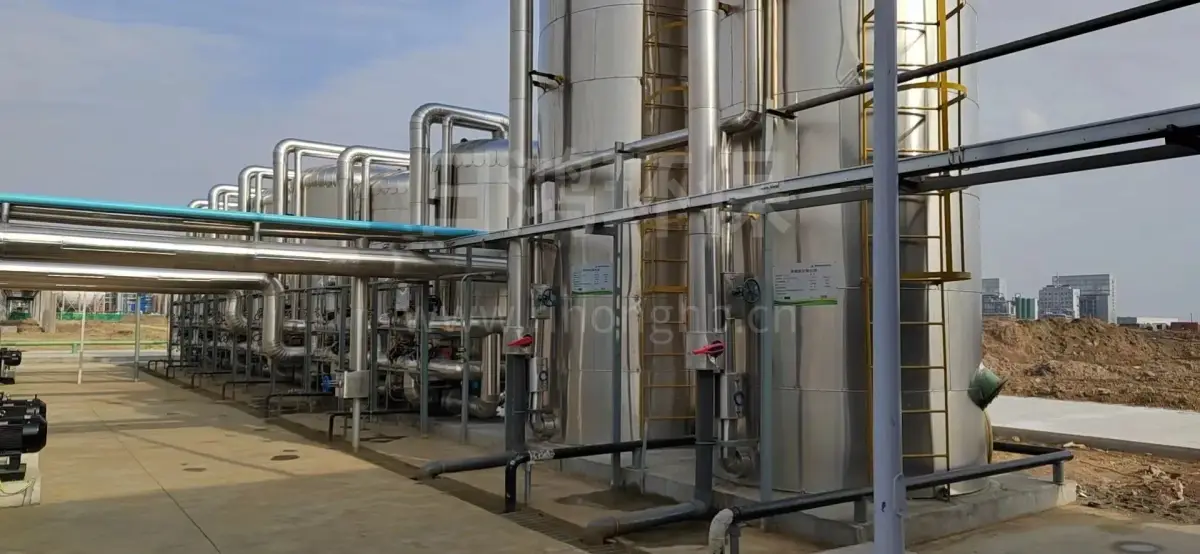
The heterogeneous catalytic oxidation tower is a vertical oxidation reaction equipment packed with solid supported catalyst, usually equipped with an ozone generator, water and gas distribution system, and tail gas destroyer, forming a complete advanced oxidation process (AOP) advanced treatment unit. It integrates "ozone oxidation + heterogeneous catalysis" into one tower, used for advanced treatment of biological effluent, RO concentrate/zero liquid discharge pretreatment, upgrading of comprehensive wastewater in industrial parks, and detoxification and cell wall breaking of toxic organic matter. With modular packing and operation at room temperature and pressure, it solves the pain points of large sludge volume from homogeneous Fenton and low utilization of ozone alone.
II. Working Principle (Brief)
Influent pretreatment: Wastewater undergoes pre-treatment such as hardness removal and suspended solids removal to reduce the risk of catalyst compaction and fouling before entering the oxidation tower.
Water and gas distribution: The microporous gas distribution and water distribution system at the bottom of the tower enables ozone gas and wastewater to contact uniformly in countercurrent/co-current flow within the catalyst bed.
Catalytic activation: Ozone is activated and decomposed at the active sites of the solid catalyst, converting into a large amount of highly active hydroxyl radicals (·OH).
Free radical oxidation: ·OH non-selectively attacks organic matter, causing chain breakage, ring opening, and mineralization into small molecule acids, CO₂, and H₂O, simultaneously achieving decolorization and detoxification.
Tail gas destruction: Unreacted residual ozone is decomposed into oxygen by the tail gas destroyer and safely discharged, avoiding ozone escape.
Effluent to subsequent process: The oxidized effluent has improved biodegradability, reduced COD and color, and enters the aerated biological filter, activated carbon filter, or meets discharge standards.
Process flow: Biological tailwater / RO concentrate → hardness and suspended solids removal pretreatment → catalytic oxidation tower (O₃ + solid catalyst) → effluent (COD↓, color↓, biodegradability↑) → subsequent advanced treatment
The core mechanism lies in the solid catalyst providing abundant active sites, reducing the energy barrier for ozone decomposition, converting "highly selective, low utilization" ozone into "non-selective, highly active" ·OH, thereby significantly improving ozone utilization and organic matter mineralization rate. Compared with homogeneous Fenton (dosing soluble iron salts), the catalyst exists in solid phase and basically does not dissolve out, avoiding the generation of iron sludge from the source.
III. Core Advantages
① Significant sludge reduction: The catalyst is solid phase, no soluble iron salt dosing, avoiding iron sludge from the source, significantly reducing hazardous waste disposal costs.
② Wide pH adaptability: Stable operation in neutral to weakly acidic range, eliminating the harsh strong acid (pH 2–4) adjustment and neutralization steps of homogeneous Fenton.
③ High ozone utilization: Catalyst activation enables more complete conversion of ozone to ·OH, resulting in better chemical consumption and operating costs than ozone oxidation alone.
④ Non-selective mineralization: ·OH radicals break chains and open rings, simultaneously reducing COD, decolorizing, breaking biotoxicity, and improving biodegradability.
⑤ Room temperature and pressure operation: No high temperature or pressure required, small footprint, stable operation, easy to couple and integrate with existing biological/membrane systems.
⑥ Regenerable catalyst: Modular packing, in-situ backwash regeneration or packing replacement after activity decay, convenient maintenance and controllable lifespan.
IV. Main Technical Parameters (Reference Range)
Item | Parameter Range / Description | Remarks |
|---|---|---|
Single tower treatment capacity | 1 – 500 m³/h | Expandable by parallel towers, typical range reference |
Influent COD (advanced stage) | ≤ 300 mg/L | Suitable as advanced treatment after biological process, typical range reference |
COD removal rate | 20% – 60% | Varies with water quality and ozone/catalyst conditions, typical range reference |
Ozone dosage | 30 – 150 g O₃/m³ water | Determined by target removal rate and water quality bench test, typical range reference |
Empty bed contact time (EBCT) | 20 – 60 min | Affects oxidation degree, typical range reference |
Catalyst packing height | 1.5 – 3.0 m | Supported active packing, typical range reference |
Operating pH | 5 – 9 | Can operate near neutral, typical range reference |
Working pressure | Atmospheric or slight pressure 0.05 – 0.30 MPa | Depends on gas distribution and process, typical range reference |
* The above are typical range reference values. Actual scale, removal rate, and chemical consumption are determined by design calculation and on-site bench test/commissioning.
V. Typical Application Scenarios
Scenario / Industry | Adaptation Description / Main Removal Target |
|---|---|
Comprehensive wastewater in chemical industrial parks | Advanced treatment of biological effluent, reducing COD, improving biodegradability, ensuring discharge standards |
Pharmaceutical wastewater | Detoxification of refractory mother liquor and antibiotic residues, reducing biological inhibition |
Printing and dyeing wastewater | Efficient decolorization, reducing TOC, breaking azo/anthraquinone chromophores |
Coking / coal chemical wastewater | Chain breaking and mineralization of phenols, cyanides, and polycyclic aromatic hydrocarbons, reducing biotoxicity |
Landfill leachate NF/RO concentrate | Reducing COD, alleviating membrane fouling, pretreatment for zero liquid discharge (ZLD) |
Petrochemical / fine chemical | Detoxification of refractory toxic organics, ensuring downstream stability |
Electroplating / PCB wastewater | Combined with complex breaking, reducing COD, as a final polishing unit |
VI. Applicable Boundaries and Selection Recommendations
This product is suitable as an advanced treatment after biological process, RO concentrate pretreatment, and oxidation polishing unit for refractory toxic wastewater. Influent hardness and suspended solids should be controlled to prevent catalyst bed compaction and fouling; if the water contains high concentrations of radical scavengers such as sulfite and carbonate, it will inhibit ·OH efficiency and requires pre-removal or process adjustment. Ultra-high concentration organic raw water should be prioritized for biological/physicochemical pretreatment and should not directly enter the tower.
Selection is determined by water volume, influent COD and biodegradability, and target removal rate to comprehensively determine tower diameter and catalyst packing amount; different support systems (e.g., active components, carriers) have significantly different adaptability to different water qualities. It is recommended to first conduct water quality bench tests to select and verify the catalyst, then scale up accordingly. For operation and maintenance, regular backwashing to prevent compaction, monitoring catalyst activity and ozone utilization, and ensuring the tail gas destroyer is always on for safety are required.
FAQ
How much does this equipment cost?
The price varies by treatment capacity, water quality, materials and configuration, so a custom quote is provided based on your actual conditions. We offer free water testing and solution design, with a detailed quote within 1 working day after requirements are confirmed.
What treatment capacity is available? Can it be customized?
Capacity is fully customizable, ranging from tens to thousands of tons per day (e.g. 0.5–30 m³/h), with non-standard design support matched precisely to your inlet/outlet requirements.
How long does delivery take?
Standard equipment typically takes about 2–4 weeks to produce; custom projects depend on scale and process. The delivery date is confirmed at contract signing, with design, manufacturing and shipping progressing on schedule.
Is installation and commissioning included?
Yes. We provide installation, system commissioning, operator training and environmental acceptance assistance, as well as long-term managed operation services on request.
What about after-sales and warranty?
We provide a warranty period and a 24/7 technical hotline, with free repair for non-human faults during the warranty period, plus spare parts supply and regular inspection services.
Let refractory water pass through catalytic oxidation first
Rihong Environmental can provide process selection, catalyst matching bench tests, and complete equipment solutions for heterogeneous catalytic oxidation towers. Welcome to call or leave a message for a customized design.
Contact Us Now →Related Products
Iron-Carbon Micro-Electrolysis
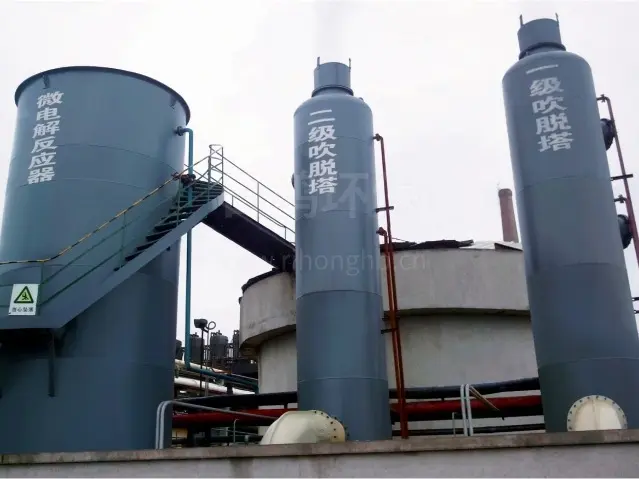
Faced with complex wastewater from industries such as printing and dyeing, pharmaceuticals, chemicals, and electroplating—characterized by "high color, high toxicity, and poor biodegradability (B/C often below 0.2)"—traditional biological treatment often falls into the dilemma of "can accept it, but cannot degrade it," while direct advanced oxidation is costly. Iron-carbon micro-electrolysis (internal electrolysis) uses iron scraps and carbon packing to form countless microscopic galvanic cells, enabling in-situ chain scission, decolorization, and biodegradability improvement without external current, "reducing the load and opening the way" for downstream biological or Fenton treatment.
Electro-Fenton
Pharmaceutical, printing and dyeing, chemical, landfill leachate and other refractory wastewater often contains highly toxic, highly colored, and poorly biodegradable organics. Traditional Fenton requires purchasing and storing large amounts of hydrogen peroxide and ferrous salts, involves high chemical dosing, produces large amounts of iron sludge, and demands strict pH control. This product electrochemically generates Fe²⁺ and H₂O₂ in situ within the reactor and uses current to drive the Fe³⁺/Fe²⁺ cycle. It features low chemical dosing, greatly reduced iron sludge, and a controllable operation process, making it an efficient choice for pretreatment and advanced oxidation of refractory wastewater.
Fenton Reactor
Refractory wastewater from pharmaceutical, printing and dyeing, chemical, and landfill leachate sources often contains highly toxic, highly colored, and poorly biodegradable organic matter. As the most mature homogeneous advanced oxidation process in application, Fenton oxidation involves dosing ferrous salts and hydrogen peroxide into acidic wastewater to generate highly active hydroxyl radicals (·OH) in situ, which break molecular chains and mineralize organic matter—the process is mature, fast to start, low in investment, and easily integrated with existing facilities. It remains one of the most commonly used and most reliable means for advanced treatment and pretreatment of refractory wastewater.