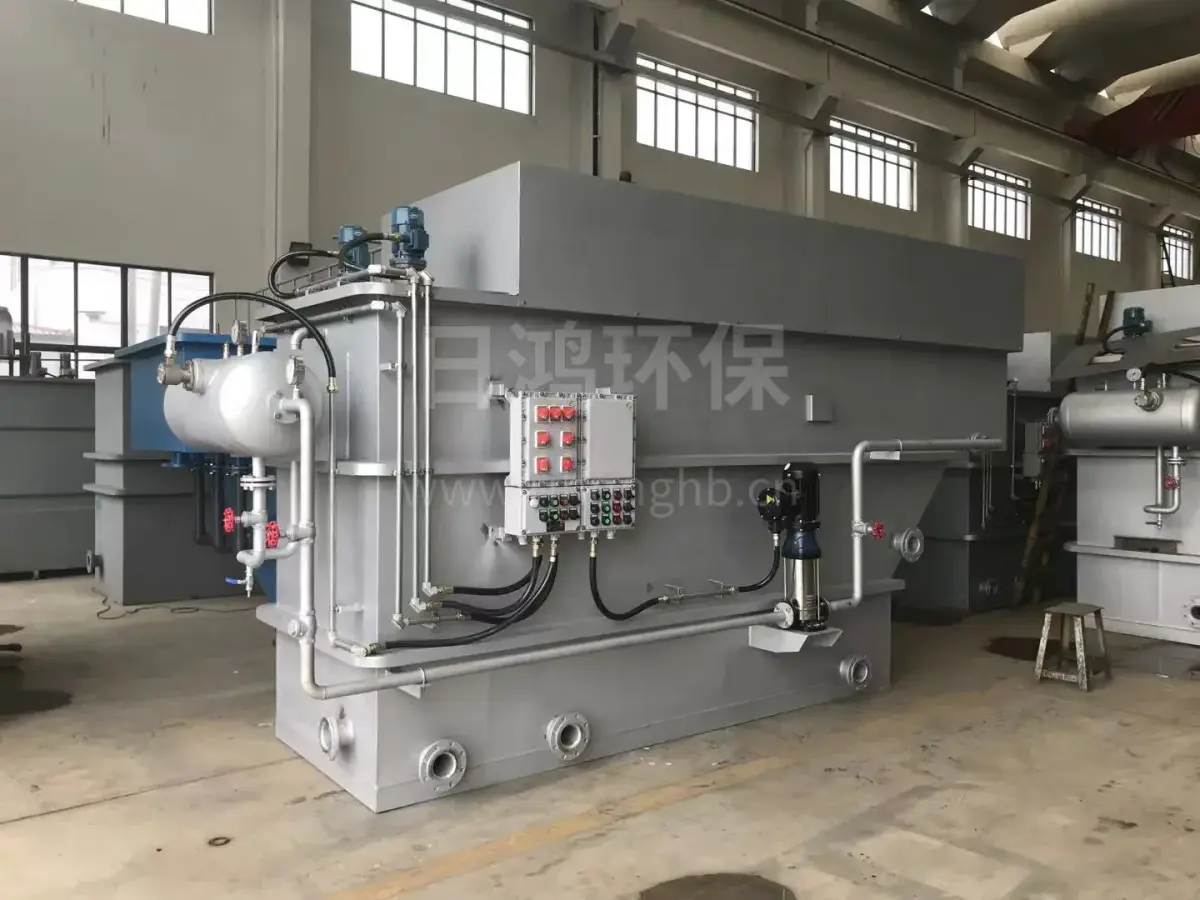
Shallow Scraper DAF
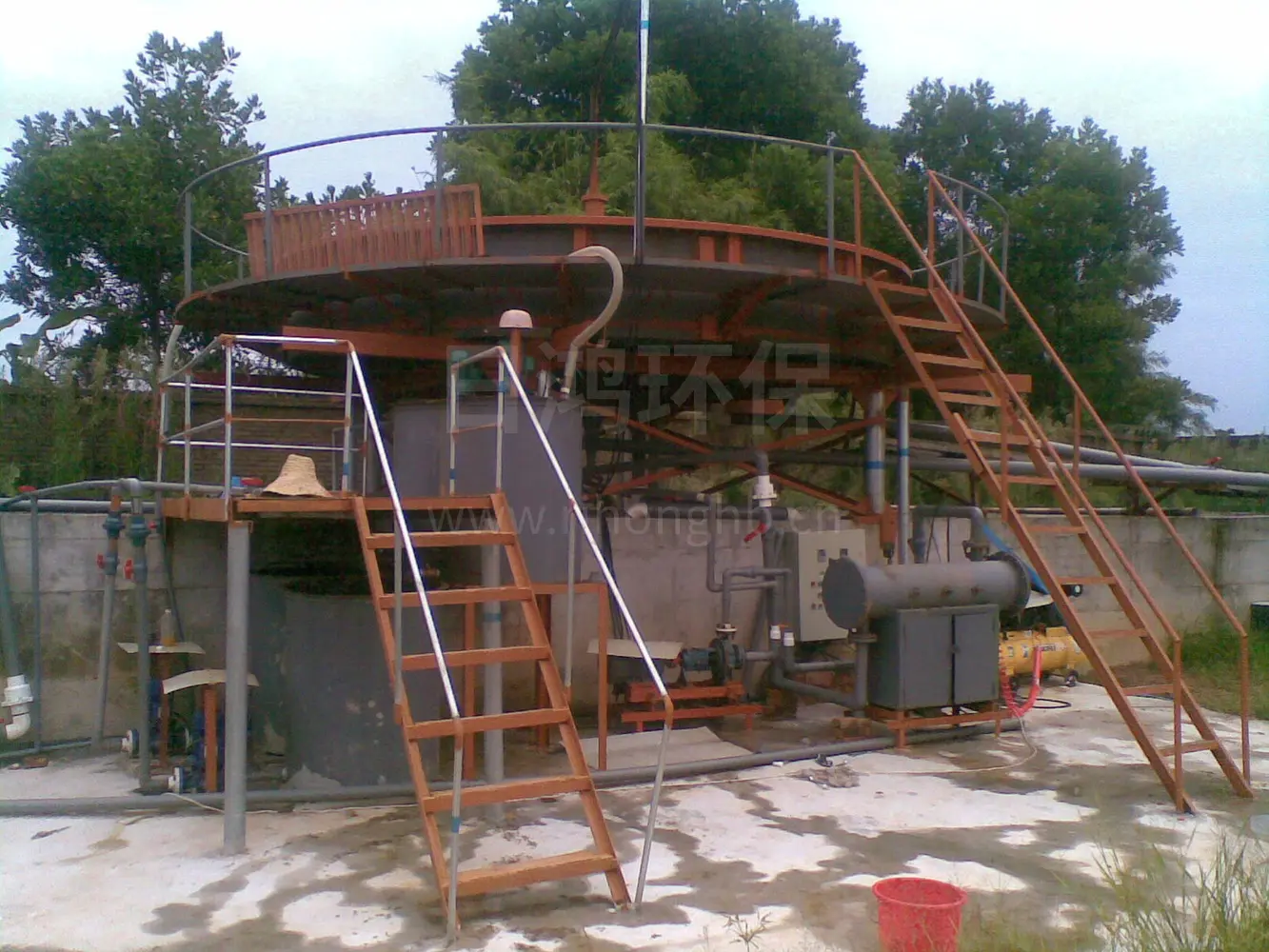
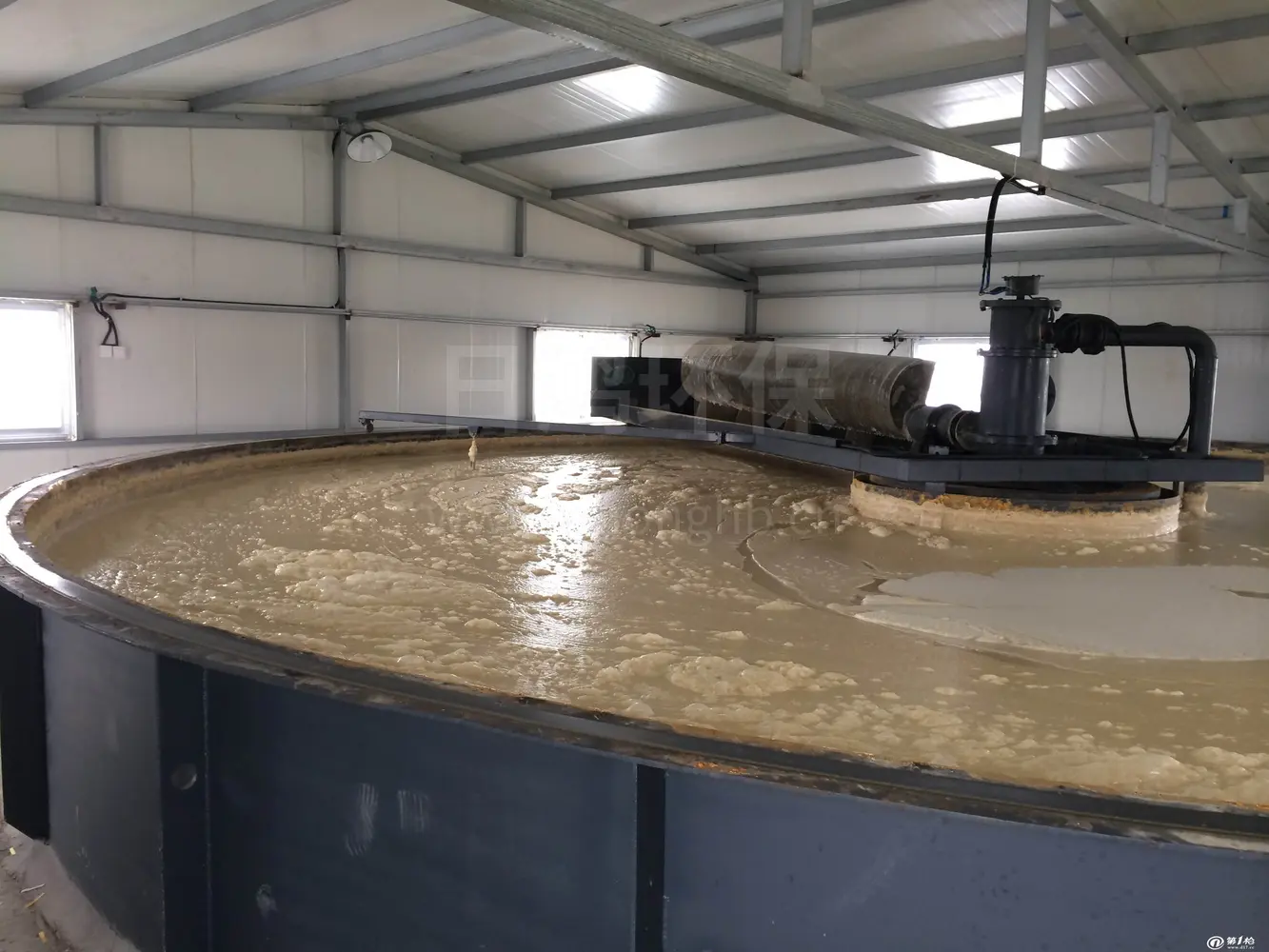
Facing the challenges of algae removal in water supply, low-temperature low-turbidity water, papermaking whitewater, food oils and greases, and petrochemical oily wastewater—where "lightweight pollutants won't settle and occupy large areas"—traditional dissolved air flotation (DAF) tanks are deep, have long retention times, and require large footprints, often becoming the land bottleneck for water treatment plants. Rihong Environmental's Shallow Scraper DAF implements the "shallow pool theory" as a circular shallow tank unit—with a tank depth of only about 650 mm, center inlet, peripheral outlet, and rotating scraper—greatly shortening the bubble rise path. The surface loading is several times that of traditional DAF, with a retention time of only 3–5 minutes, achieving a smaller footprint and clearer effluent at the same treatment capacity.
I. Product Positioning
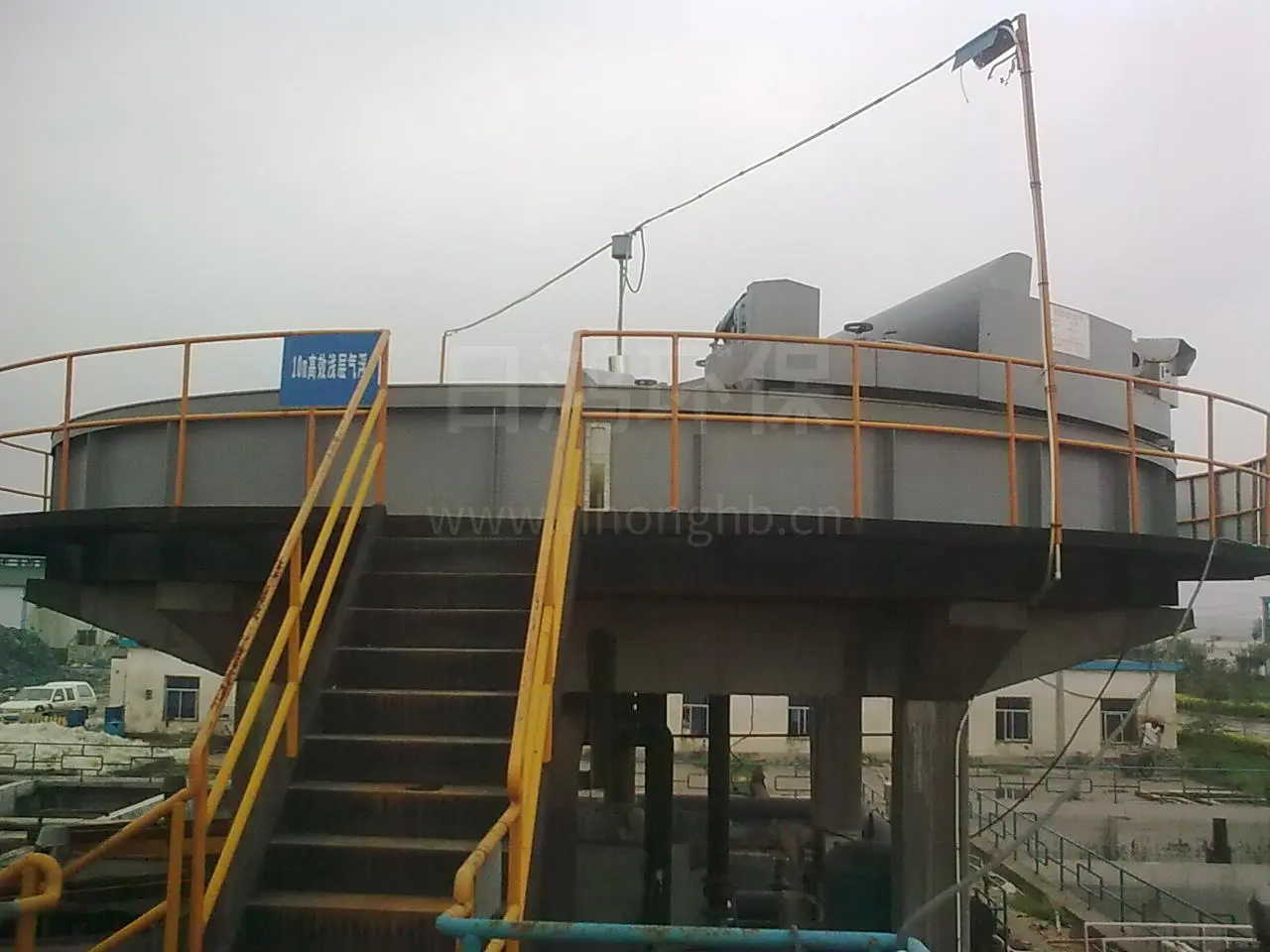
The Shallow Scraper DAF is a highly efficient improved version of Dissolved Air Flotation (DAF), featuring a circular shallow tank structure, uniform water distribution via central inlet pipe, peripheral effluent via collection weir, and continuous scum removal by rotating scraper. The equipment integrates coagulation reaction, dissolved air water preparation and release, contact flotation, rotating scraping, and clear water recirculation into a single steel (or stainless steel) skid-mounted unit. It can operate independently as a single unit or be expanded in parallel with multiple units. It is the core equipment for high-speed separation of "lightweight difficult-to-settle pollutants" in water supply purification and wastewater upgrading.
II. Working Principle (Brief)
Coagulation reaction: Raw water and added chemicals are rapidly mixed in pipes or reaction chambers to form micro-flocs that easily attach to bubbles.
Central water distribution: Raw water is evenly distributed into the shallow tank through the central inlet pipe, with low hydraulic turbulence and more balanced distribution.
Dissolved air release: Pressurized dissolved air water forms 20–40 μm micro-bubbles through the release device in the tank, fully contacting and combining with flocs and oil droplets.
Rapid flotation: Bubbles lift pollutants, rapidly floating to the surface in the extremely shallow water layer to form a scum layer.
Rotating scraping: The rotating scraper continuously revolves along the tank surface, scraping scum into the discharge hopper and discharging it, with no cleaning dead zones.
Clear water collection and discharge: Clarified water is collected and discharged from the peripheral collection weir, with part of the effluent pressurized and recirculated for dissolved air water preparation, operating in a cycle.
Process flow: Raw water + chemicals → Coagulation reaction → Central water distribution → Dissolved air micro-bubble release → Flotation separation → Rotating scraping → Clear water effluent (partial recirculation for dissolved air)
The core lies in the "shallow pool theory": the tank depth is only about 600–700 mm, greatly shortening the bubble rise path. Combined with central water distribution and rotating scraping, the surface loading can reach several times that of traditional DAF, with a hydraulic retention time of only 3–5 minutes, thereby achieving higher treatment efficiency with a smaller footprint.
III. Core Advantages
① Shallow tank efficiency Tank depth of only 600–700 mm, surface loading several times that of traditional DAF, significantly improved treatment capacity per unit area.
② Extremely short retention Hydraulic retention of only 3–5 minutes, compact equipment, small footprint, saving civil construction and investment.
③ Continuous rotating scraping The rotating scraper continuously revolves along the tank surface, uniformly discharging scum with low moisture content and no cleaning dead zones.
④ Uniform water distribution Hydraulic organization with central inlet and peripheral outlet, stable flow pattern, more sufficient micro-bubble attachment.
⑤ Fine micro-bubbles 20–40 μm micro-bubbles, large contact area with flocs/oil droplets, high adhesion rate, thorough separation.
⑥ Compact integration Circular steel (or stainless steel) skid-mounted, easy installation, flexible capacity expansion with multiple units in parallel.
IV. Main Technical Parameters (Reference Range)
Item | Parameter Range / Description |
|---|---|
Tank type | Circular shallow tank (central inlet, peripheral outlet, rotating scraping) |
Tank depth | 600–700 mm (typical range reference) |
Surface loading | 8–15 m³/(m²·h) (typical range reference) |
Hydraulic retention time | 3–5 min (typical range reference) |
Dissolved air pressure | 0.3–0.5 MPa (typical range reference) |
Recirculation ratio | 20–30% (typical range reference) |
Micro-bubble diameter | 20–40 μm (typical range reference) |
Scum scraping method | Rotating scraper (typical range reference) |
Main material | Anti-corrosion carbon steel / stainless steel (typical range reference) |
Control method | PLC automatic (including dissolved air and scraping linkage) (typical range reference) |
* The above are typical range reference values. Actual tank depth, loading, retention, etc., shall be determined by design calculation and on-site commissioning.
V. Typical Application Scenarios
Scenario / Industry | Adaptation Description / Main Removal Target |
|---|---|
Water supply purification (algae removal / low-temperature low-turbidity / odor) | Replaces part of traditional sedimentation, small footprint, high algae and suspended solids removal efficiency |
Papermaking whitewater | Fiber recovery and recycling, saving clear water and fibers |
Printing and dyeing wastewater | Color, suspended solids, and partial colloid removal, beneficial for subsequent biological treatment |
Food / oil wastewater | Separation of floating oil and suspended organics, reducing downstream load |
Municipal wastewater upgrading | High-speed removal of lightweight SS in Grade I-B to Grade I-A upgrading |
Petrochemical oily wastewater | Oil-water separation, enrichment and removal of floating oil and emulsified oil |
Aquaculture / slaughterhouse wastewater | Separation of oils, debris, and organic suspended solids |
VI. Applicable Boundaries and Selection Recommendations
Applicable: High-efficiency separation of "difficult-to-settle pollutants" such as suspended solids lighter than water, oils, algae, and colloids; Not applicable: Heavy particles with specific gravity close to or greater than water are still more economical to treat by sedimentation; shallow DAF is not suitable.
Distinction from horizontal flow DAF: Shallow DAF is a circular shallow tank (about 650 mm) + rotating scraping + retention 3–5 min + high surface loading + small footprint; horizontal flow DAF is a rectangular deep tank (1.5–2.5 m) + co-current scraping + retention 10–30 min, offering more "stable" treatment but a larger footprint.
Distinction from electrocoagulation DAF: Shallow DAF uses pressurized dissolved air + external chemical coagulation, while electrocoagulation DAF uses electrochemical in-situ coagulation + cathodic hydrogen micro-bubbles (electricity instead of chemicals); all three are DAF equipment, but the mechanisms and chemical dosing methods differ.
Selection and O&M: For large water volumes, limited footprint, and priority on algae and oil removal, choose shallow DAF; the dissolved air system (air compressor, dissolved air tank, release device) must be regularly maintained; in northern regions, attention should be paid to winter insulation and freeze protection.
Product Images
FAQ
How much does this equipment cost?
The price varies by treatment capacity, water quality, materials and configuration, so a custom quote is provided based on your actual conditions. We offer free water testing and solution design, with a detailed quote within 1 working day after requirements are confirmed.
What treatment capacity is available? Can it be customized?
Capacity is fully customizable, ranging from tens to thousands of tons per day (e.g. 0.5–30 m³/h), with non-standard design support matched precisely to your inlet/outlet requirements.
How long does delivery take?
Standard equipment typically takes about 2–4 weeks to produce; custom projects depend on scale and process. The delivery date is confirmed at contract signing, with design, manufacturing and shipping progressing on schedule.
Is installation and commissioning included?
Yes. We provide installation, system commissioning, operator training and environmental acceptance assistance, as well as long-term managed operation services on request.
What about after-sales and warranty?
We provide a warranty period and a 24/7 technical hotline, with free repair for non-human faults during the warranty period, plus spare parts supply and regular inspection services.
Make lightweight pollutants "float"—smaller footprint, clearer effluent
Rihong Environmental's Shallow Scraper DAF offers a complete solution from water quality bench testing and equipment selection to skid-mounted delivery. Welcome to call or leave a message for customized selection and quotation.
Contact Us Now →